InsightsHospitality
Sleep appears in no room programme: longevity in hotels, thought through before the competition
A room programme can only list what belongs to a room. Sleep, daily rhythm and encounter arise between the rooms and do not appear in it. A longevity hotel therefore begins with a day in the house. The room programme follows from it, before the architectural competition.
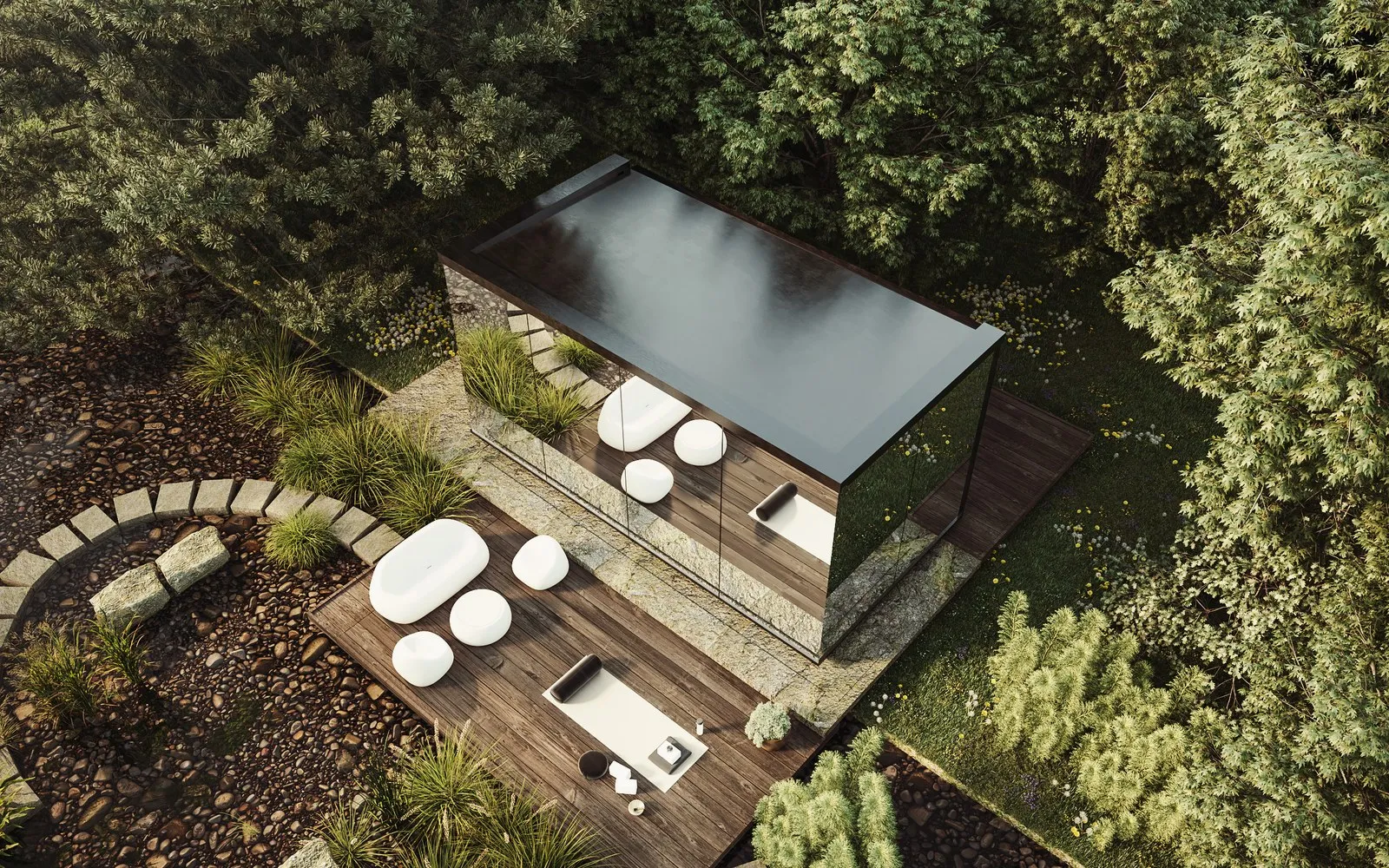
GYMPA vision study, concept visualisation
What has no line
Every room programme wants to achieve something. A good client’s brief asks exactly that, and the German standard DIN 18205 describes it as the client’s task at the start of a project.2 So the limit is not the intention. It is the form: a room programme is a list of rooms with areas. What belongs to no room has no line in it. And what has no line easily ends up without a budget and without anyone responsible.
Many of the effects that matter in a house for health are of this kind. Good sleep depends on where a room lies, what happens beneath it, how bright the corridor is at night and when the kitchen closes. A daily rhythm arises from light, routes and hours. Encounter happens where routes cross. None of this belongs to one room alone.
The body does not know this division anyway. It regulates across the whole day, not room by room.
A chain and a loop
A project often begins with a programme taken from comparable projects and operator standards, for example square metres of spa per key. It contains an assumption about effect that is rarely tested afterwards. From there the project runs like a chain: competition, tender, fit-out, operator, opening. Each hands over to the next, and those who know the daily life of a house best often join last. Whether it works shows at the end.
The other route begins with a day in the house. Client, operations and medicine play it through together, hour by hour, for the guests and for the team. It yields conditions, the conditions yield rooms, and only then comes a programme. The same day remains the test afterwards: for the programme, for the design, for the fit-out and, after opening, for operations. The chain becomes a loop. This is how GYMPA begins projects.
Chain
- Room programmefrom benchmarks
- Competition
- Fit-out
- Operatoroften joins only now
- Impactshows at the end
Loop
- A day in the housewith operations and medicine
- Room programmeis derived
- Competition
- Fit-out
- Impact
Every step is tested against the same day in the house
An example: the night
A house wants its guests to sleep well. The programme names rooms, bar, spa and diagnostics. Sleep does not appear in it. So the rooms face the view, the bar lies beneath them, the corridor stays bright, and at the end a device measures a sleep that the house itself disturbs.
Play the night through beforehand and the requirements change:
- The rooms lie on the quiet side, even if the view is on the other.
- The bar is not beneath them, and the night service route does not pass them.
- The light in the house recedes in the evening. The recommendation is at most ten lux of melanopic light in the three hours before bed, and at most one while asleep.3
- The spa is warm late in the evening, with the space and the time its team needs for that.
- Diagnostics gets less area for devices and more for conversation.
This is not the same house with better reasons. It is a different house.
Why before the competition
A competition answers what it is asked. Germany’s guideline for planning competitions says so explicitly: the client describes the task clearly and unambiguously, and names the aims, any binding requirements and the criteria for judging. The jury assesses the entries against exactly these.1 What the brief leaves out, a design may bring along by chance. It can be neither required nor compared. If the day in the house is part of the brief, the jury can compare which design carries it.
Cost also speaks for the early moment. Before the competition, a mistake in the programme costs a correction on paper. Afterwards it costs area, alterations or permanent staff.
Seven questions for the day in the house
Seven disciplines shape this day. Each comes with a question that can be answered before the design, and with something that can go into the brief.
Architecture
What rhythm should a day in this house have?
A person is not a device to be set to one state. A person regulates: through light and darkness, warmth and coolness, company and retreat, movement and rest. A building sets this alternation long before the first treatment is booked. Sleep and circadian experts recommend that healthy adults get at least 250 lux of melanopic light at eye level during the day.3 Where a room lies, how deep it is and where it opens is decided by the design.
In the brief: Daylight, darkness, quiet and routes as aims with criteria of their own, not only as areas.
Technology
What should the house notice, and what should it deliberately not?
When technology is tendered by specification, a data sheet decides what is recorded, who sees it and what follows from it. Before the design, this can be thought the other way round: which feedback helps guests to understand themselves better? Which helps the team? Which data stays with the guest? Under European law, health data is specially protected. Processing it is prohibited in principle unless an exception applies, such as explicit consent.4 That belongs in the planning, not at its end.
In the brief: A position on data in three sentences, and reserves in shafts, power and network for technology that does not exist yet.
Design
How does the way feel, from arrival to the room?
Atmosphere is usually decided during the interior fit-out, when space and technology are fixed. Yet it acts first, and on everyone: through material, sound, scent, temperature and scale. Guests don’t remember individual amenities, they remember the quality of an experience. That quality is less a style than a sequence of transitions, from loud to quiet, from bright to dimmed, from shared to one’s own.
In the brief: Five to seven such transitions, described in words and without prescribing a style.
Fitness
Where does movement come naturally, even without an appointment?
A gym is the smallest answer to this question. Movement also happens on the way to breakfast, on a staircase in daylight, outside the door. In a small experiment, students did markedly better on a concentration test after a 50-minute walk in a park than after a walk of the same length downtown.5 So it also matters where we move.
In the brief: Routes, stairs and outdoor spaces as part of the movement concept, with areas that can change their use over the years.
Diagnostics
What happens after the result?
Diagnostics often becomes an offer of its own, with a partner of its own. But a value is a sign, not a goal. It describes one moment in an organism that keeps changing. It becomes useful when someone puts it into context and when the house can respond: with rest, food, movement, a conversation. Settling this early may mean fewer machines in the end, and more time.
In the brief: A discreet place for conversation and interpretation, close to everything else rather than at the end of a corridor. And a statement of who is professionally responsible for what happens there.
Spa
What should people recover from here, and with whom?
The spa is often set with the operator concept, apart from training and diagnostics. Recovery does not keep to this separation. It needs change: warmth and coolness, water and air, solitude and company. The last of these is easily overlooked. Across 148 studies with more than 300,000 people, those with stronger social relationships had 50 per cent higher odds of survival during follow-up.6 This shows an association, not a cause. For a house it becomes a question: where do people meet here without it being an item on the programme?
In the brief: Retreat and encounter as uses of equal standing, spatially connected with movement and diagnostics.
Operations
Who carries the effect on day one thousand?
Operations begin after opening and have to work with everything decided before. That is why their question belongs at the start: how many people does the house need, which skills, which routes behind the scenes? And are they well? A house that calms its guests and exhausts its team has only moved the load.
In the brief: One day of operations in hours, written with someone who runs houses. Even if the operator has not been chosen yet.
How this becomes a brief
Often a few pages are enough:
- One sentence on effect: what should this place make possible in the lives of guests and team?
- A day in the house, hour by hour, once for a guest and once for the team.
- Three fields of effect that take priority. The GYMPA Field distinguishes nine, from movement and recovery to social connection and rest.
- The conditions that follow, including those between the rooms: position, light, noise, routes, hours.
- The room programme, derived from these conditions.
- A few binding requirements, criteria for judging and at least one jury member who knows operations and health from experience. The German guideline provides for jurors who are particularly familiar with the task.1
This does not constrain the design. It gives the design a question worth answering.
And if the competition is already running?
Then the colloquium is the right moment. It serves to make the task more precise, and under the German guideline its minutes become part of the brief.1 If the competition has been decided, the day in the house can still be played through, for fit-out, operations and programme. The lever is smaller then, but the loop can begin there too.
Sources
- German Guideline for Planning Competitions (RPW 2013), § 5(1) and § 6, in German.
- DIN 18205:2016-11, Brief for building design.
- Brown et al.: Recommendations for daytime, evening, and nighttime indoor light exposure. PLOS Biology 20(3), 2022. For healthy adults with regular daytime schedules.
- General Data Protection Regulation, Art. 9(1) and (2).
- Berman, Jonides, Kaplan: The cognitive benefits of interacting with nature. Psychological Science 19(12), 2008. 37 students.
- Holt-Lunstad, Smith, Layton: Social relationships and mortality risk. PLOS Medicine 7(7), 2010. Observational studies, odds ratio 1.50.
The right time is earlier.
If your project is still open, we are glad to talk about what it should make possible.